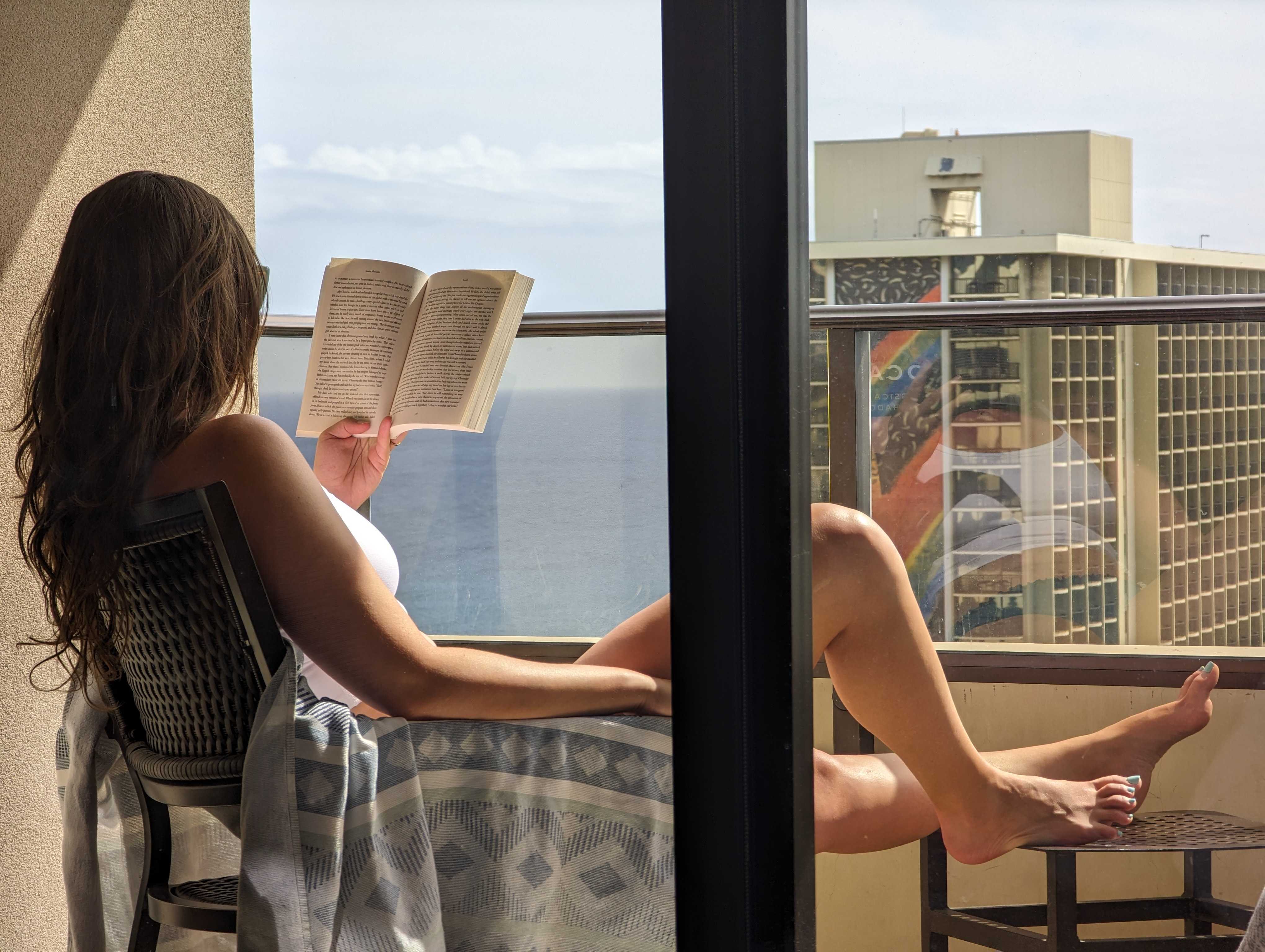
I’m not a big New Year’s Resolution guy. But, I do set myself up with a reading goal each year. At the beginning of 2020, I set my goal at 12 books. Due to a variety of factors, I hit that number in May. At that pace, I kicked the goal up higher – 31 books. By the time 2021 began, I was in the middle of book number 24 – and I’m using that one towards 2021’s count. That makes it 23 books in total read during 2020. Here they are; listed in the order I read them:
- Dune by Frank Herbert
- Blink by Malcolm Gladwell
- The 25th Hour by David Benioff
- Station Eleven by Emily St. John Mandel
- Do Androids Dream of Electric Sheep? by Philip K. Dick
- Eating the Dinosaur by Chuck Klosterman
- Calico Joe by John Grisham
- Ready Player One by Ernest Cline
- The Genius of Desperation by Doug Farrar
- History of the Rain by Niall Williams
- Meet Me in the Bathroom by Lizzy Goodman
- The Last Emperox by John Scalzi
- South of Broad by Pat Conroy
- David and Goliath by Malcolm Gladwell
- Sag Harbor by Colson Whitehead
- Talking to Strangers by Malcolm Gladwell
- This is How You Lose the Time War by Max Gladstone and Amal El-Mohtar
- Upstream by Dan Heath
- Siddhartha by Herman Hesse
- The Art of Fielding by Chad Harbach
- East of Eden by John Steinbeck
- The Cost of These Dreams by Wright Thompson
- The Zero by Jess Walter
If you’re reading this and you don’t know me, you’re probably rolling your eyes at the number of Malcolm Gladwell books. I didn’t plan it that way, but early on in the year I was able to get this whole thing started when, after finishing Dune, I picked up Blink and started reading.
The problem I ran into in 2019 was not being able to move onto the next book – this was especially pronounced after reading Blood Meridian by Cormac McCarthy. I finished and thought, “Wow, that was great. I don’t think I’ll read something like that again anytime soon.” I remember trying to read Station Eleven – which I eventually returned to this year (2020) – and I couldn’t get through it. I couldn’t get my mind away from the hellish realism of Blood Meridian. I needed a pallet cleanser.
That’s where I was after Dune. In need of a palate cleanser, and Blink would be perfect. (I really enjoy Malcolm Gladwell’s podcast, and I had read Outliers years earlier.) A pickle spear on my plate after the double cheeseburger that was Dune. The other key to this was it was non-fiction. And one thing I learned was that if you have a book goal, and you tend to get hung up after reading a good novel like I do, make sure the next book you pick up is non-fiction.
So, that’s what I did. It wasn’t always necessary, but when I finished something really gripping it was a good tool to keep the train moving.
Taking a look at the numbers, I read 8 non-fiction books and 15 works of fiction. I’m a big sports fan (4 of the books I read were about sports) and in sports there are always power rankings. I don’t think books, movies and art deserve the same treatment however – you’d be better served watching the movies nominated for best picture as opposed to just the best picture winner (but really, do this with original screenplay). Still, the sports fan in me has this need to tell you which of these books I think were the best. In order to sidestep this a little bit, this will be a subjective metric. East of Eden was probably the “best” book I read this year, but it was only one of my favorites.
I’ll break it down between fiction and non-fiction and give out my two favorites for each.
Top 2: Fiction
History of the Rain by Niall Williams
I read History of the Rain in early spring. I’ll start with a bit of a disclaimer: I recommended this heavily after I read it. I told my girlfriend, Lacey, to read it immediately, and I’m pretty sure I bought it for my Mom for Mother’s Day. Neither of them really liked it. I think Lacey finished it begrudgingly and I’ll have to check, but I don’t think my Mom got through it. And if you’ve never heard of the book before or have yet to look it up, it’s not a “dude’s book.” The main character is a bedridden college age girl in a small town in Ireland who is obsessed with books and may or may not be dying.
Last year I started keeping a log of the books I read in one of those mid-sized Moleskine notebooks. I came up with four prompts to respond to after I finished reading a novel:
- Why did you read this book?
- Favorite character?
- Best moment?
- Favorite quote?
The quote I chose for History of the Rain might be the favorite thing I read this past year. Ruth, the protagonist, is talking about myths and Ireland, and Irish people.
We’re a race of elsewhere people. That’s what makes us the best saints and the best poets and the best musicians and the world’s worst bankers. That’s why wherever you go you’ll see some of us — and it makes no difference if the place is soft and warm and lovely and there’s not a thing anyone could find wrong with it, there’ll always be what Jimmy the Yank calls A Hankering. It’s in the eyes. The idea of a better home. Some have it worse than others. My Father had it running in the rivers of him.
History of the Rain
When I read that I thought to myself that maybe Niall Williams wrote this entire book just so he could say this one thing.
The Art of Fielding by Chad Harbach
I don’t know how I hadn’t read this book earlier. One of my best friends counts it among his favorite novels, and had recommended it to me for years. I finally read it this August.
I don’t know if there are two things I romanticize more than Baseball and College. This book is about Henry Skrimshander, a lanky, defensively-gifted shortstop at a small liberal arts college on a lake. I went to a small liberal arts school on a river, and was the captain of the ultimate team. This novel connected with me in a way that I haven’t experienced since I graduated in 2014. I hadn’t read anything set on a campus like that. Something that captured the way it felt to be there. I don’t know if I was actively avoiding it necessarily, but in my head I was like the guys in Kicking and Screaming (1997) — “nostalgic for conversations I had yesterday,” and I didn’t want to be.
But, I devoured this book. I loved every moment of it. I scanned some reviews on Goodreads that mention it being too long, but honestly, I wish it was like another 200 pages. They kind of gloss over sophomore year, and I would have been fine with just going through the day-to-day that year too. The recommendations went over better here — this one is Lacey approved.
He rarely slept and he rarely tired. His heart in his chest felt dangerously full, swollen and tender, like a fruit so ripe it threatens to split its skin. He wanted every day and every moment with Owen, the moments between Owen, to last and last and last. In his life he’d passed through long periods of gratefulness and good cheer, but he’d scarcely even imagined this level of thorough contentment with things as they were.
The Art of Fielding
Top 2: Non-Fiction
Meet Me in the Bathroom by Lizzy Goodman
This was the most fun I had reading anything this year — and maybe ever. I got into The Strokes during my freshman year of college, and they’ve been a staple for me ever since. A decade earlier (I was 8) and things were starting to happen in the New York rock scene.
If you are a fan of any of those bands (The Strokes, Interpol, Yeah Yeah Yeahs), and you haven’t read this, move it up into ‘next’ in your queue. Or if you are just into music or think New York is cool or wish all bands still dressed like The Strokes. I can check why I read it because it’s one of my prompts, but it’s partly because in my head this would be a really cool book to read. I was afraid it might be hard to get through and that would prove I wasn’t actually a real fan of any of these bands, and I would be exposed for just wanting to read this book because I thought it would be cool. It was the exact opposite (except it was still cool).
For non-fiction books the prompts in my logbook are slightly different:
- Why did you read this book?
- Favorite section/chapter?
- Biggest takeaway?
- Favorite quote?
Every now and then I’ll cheat and choose more than one favorite quote.
What people love about New York is what they hate about New York: it’s constantly changing. So it was always better before, whenever “before” was — basically whenever the person talking was 22.
Joe Levy, Meet Me in the Bathroom
I’m not saying any of this is something we thought of, I’m just saying, when I look back and I see pictures of us, I feel that energy. I was one of them and I look back and say, “I want to be one of them.”
Albert Hammond Jr., Meet Me in the Bathroom
Upstream by Dan Heath
The full title of this book is technically Upstream: The Quest to Solve Problems Before they Happen. And, that’s really what the whole book is about. It’s a terrific title in that sense. I heard Dan Heath promoting his book on an episode of The Good Life Project podcast, and I enjoyed the episode so much that I bought the book. The promo worked like a charm. It wasn’t long before I was reading about what Expedia did to decrease their amount of customer calls.
It was insightful, and had me shaking my head time and time again thinking about how often the type of thinking championed in this book gets disregarded for short term solutions. I’m not saying things are always easy or that I have all the answers, but often I think we aren’t even asking the right questions, and this book captures that.
What’s odd about upstream work is that, despite the enormous stakes, it’s often optional. With downstream activity — the rescues and responses and reactions — the work is demanded of us. A doctor can’t opt out of a heart surgery; a day care worker can’t opt out of a diaper change. By contrast, upstream work is chosen, not demanded. A corollary of that insight is that if the work is not chosen by someone, the underlying problem won’t get solved.
Upstream
The Rest
I wanted to touch briefly on a few more books that stand out for various reasons.
Do Androids Dream of Electric Sheep: Super weird, but good weird. I enjoyed it more than the movie though. I keep re-watching Blade Runner thinking I’m going to “get it,” and I re-watched it again after reading this. Still not for me. I really liked the sequel though.
The Last Emperox: The final installment in John Scalzi’s Interdependency trilogy, and one of the worst books I’ve read cover to cover. I had to finish it just to see how the story ended – and I already noticed things slipping in the second book – but all of the quotes on the dust jacket being about the first or second book should have been enough warning to stay away.
Sag Harbor: Really cool slice of life. They also mention my hometown of Center Moriches, NY at one point.
Ready Player One: I enjoyed this a lot. It seems to be a very polarizing book, but most of the arguments I see against it hold it up to this weird standard and critique the writing like it’s being lauded as a classic work of literature. It’s a fun story, don’t overthink it.
The Cost of These Dreams: I can’t recommend this book enough. It’s really just a collection of sports essays Wright Thompson has written over the years, but each one was compelling, and emotional, and left me with broadened perspective.
East of Eden: Believe the hype.
It’s fitting that I end that list with East of Eden because that is the book that really slowed my pace. I finished it in September. I only finished 2 more books the rest of the year. I started reading A Man Called Ove and just could not get into it, and gave up after 120 or so pages. But, that’s okay.
It’s okay that I didn’t finish a book I started. It’s okay I didn’t reach the elevated goal I set for myself. It will be okay if I don’t reach this years goal (24; one more than last year). And while I emphasized a few titles, the most important section is towards the top that lists what I read. And it doesn’t matter how many books long the list is. What’s important is that you read. Expand your thinking. Get lost in a story. Read a book for fun. Read a classic. Just read.
There are monstrous changes taking place in the world, forces shaping a future whose face we do not know. Some of these forces seem evil to us, perhaps not in themselves but because their tendency is to eliminate other things we hold good.
East of Eden
 Lemmen's Nursery